What Are the Key Parameters of Syringe Pumps?
In this article, we explain the key parameters you should consider when purchasing a syringe pump, what they mean, and why they matter. This article focuses on laboratory-type syringe pumps. Medical syringe pumps are not within the scope of this article.
Key parameters of syringe pumps:
- Flow Rate Range
- Accuracy & Precision
- Supported Syringe Volume and Type
- Maximum Force / Thrust
- Operating Modes
- Control and User Interface
- Noise, Vibration, and Flow Stability
Flow Rate Range
This is the most fundamental parameter that determines the quality of a syringe pump. While a typical syringe pump operates in the µL/min–mL/min range, high-quality syringe pumps can go down to nL/min and even pL/min levels.
For low-flow liquid transfer, small-diameter syringes should be preferred. This allows for more precise and more continuous flow. The main challenge at low flow rates is achieving pulsation-free flow. Since syringe pumps usually push and pull using stepper motors, they tend to move intermittently at extremely low speeds.
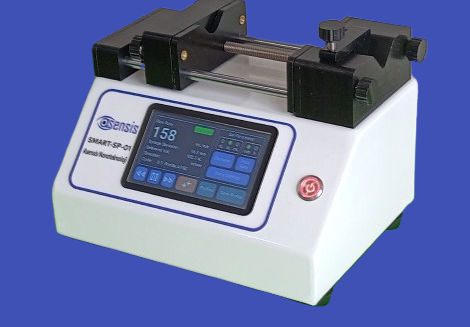
With smaller-diameter syringes, a higher linear speed is required to achieve the same flow rate. This makes it easier to maintain continuous flow. Smart systems such as SMART SP automatically calculate the lowest achievable pulsation-free flow rate based on the syringe diameter, ensuring that pulsation-free flow is always maintained.
Using large-diameter syringes makes it easier to achieve high flow rates. If you require high-speed flow, it is recommended to check the maximum flow rate of the device you are considering and verify which syringe size is used to achieve that value.
Accuracy & Precision
This parameter describes how accurately a syringe pump can deliver the requested flow rate in practice. The main factors that determine this accuracy are:
- Stepper motor resolution
- Lead screw pitch
- Mechanical backlash
Stepper motor resolution is typically 200 steps per revolution, which is not sufficient for achieving high flow accuracy—especially at pL/min levels. More advanced solutions are required, and this is where microstepping comes into play.
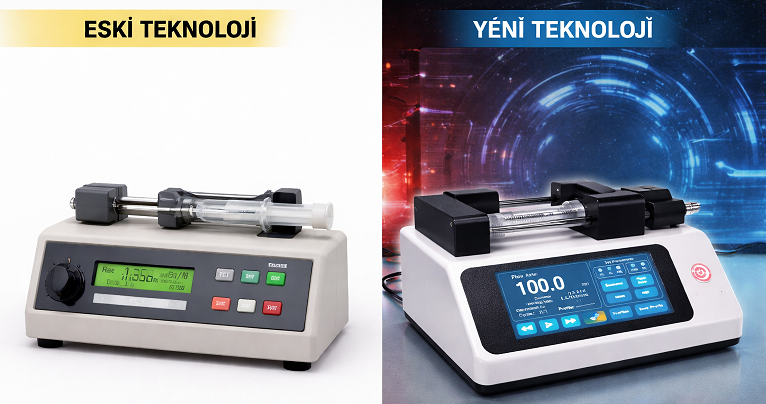
Microstepping is a technique that divides the steps of a stepper motor into smaller increments. It is achieved through advanced current control, step control techniques, and high-level embedded software. Microstepping is a relatively recent technology, which is why older syringe pump models have lower microstepping capabilities. In newer models, this level can reach extreme values.
The latest syringe pump developed in the industry is SMART SP. Designed using state-of-the-art technology, it can achieve extraordinary values such as 1/256 microstepping, resulting in an impressive resolution of 51,200 steps per revolution. While microstepping used to result in high vibration in the past, modern technology has completely eliminated this issue.
Lead screw pitch is another critical parameter that determines resolution. It refers to how far the nut on a screw advances with one full rotation. For example, in a system with an 8 mm pitch, the distance traveled per motor step is greater than in a system with a 2 mm pitch. Therefore, systems that require high flow accuracy benefit from smaller lead screw pitches.
Mechanical backlash is mainly related to manufacturing quality. Systems produced with high workmanship quality offer advantages in both accuracy and precision.
Supported Syringe Volume and Type
The syringe volume becomes important depending on the flow rate range you want to work in or the amount of liquid you want to load at once. Thanks to advanced carrier designs, modern syringe pump systems can support a wide range of syringe volumes and types. Nevertheless, you should always verify that the device you plan to purchase supports the ranges you need.
Maximum Force / Thrust
This parameter indicates how much force the device can apply to push fluids. It becomes especially important when working with high-viscosity liquids or applications that require high pressure.
Syringe pumps are generally designed to provide sufficient thrust to cover most use cases. However, if you have a specific thrust requirement, you should definitely ask the manufacturer about this value before purchasing.
Operating Modes
When talking about syringe pump modes, push and pull modes come to mind first. Advanced devices also offer a cycle feature.
Low-cost syringe pumps usually provide only the push mode. However, if you are working with microfluidics, having both push and pull modes is extremely valuable. Supporting both modes requires suitable mechanical design as well as compatible hardware and software. For this reason, these features are typically found only in high-end syringe pumps.
The cycle feature means that pushing or pulling occurs for a specified volume or duration, then stops for a defined time. The number of repetitions should also be adjustable. These are high-level features seen in devices like SMART SP, which are equipped with advanced hardware and software. The ability to define dispensing based on volume or time is another advantage provided by intelligent software.
Control and User Interface
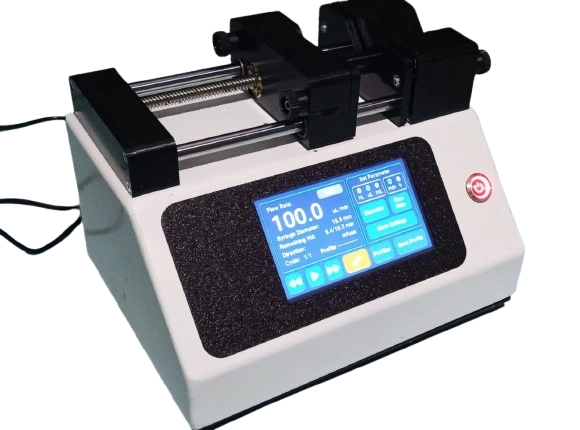
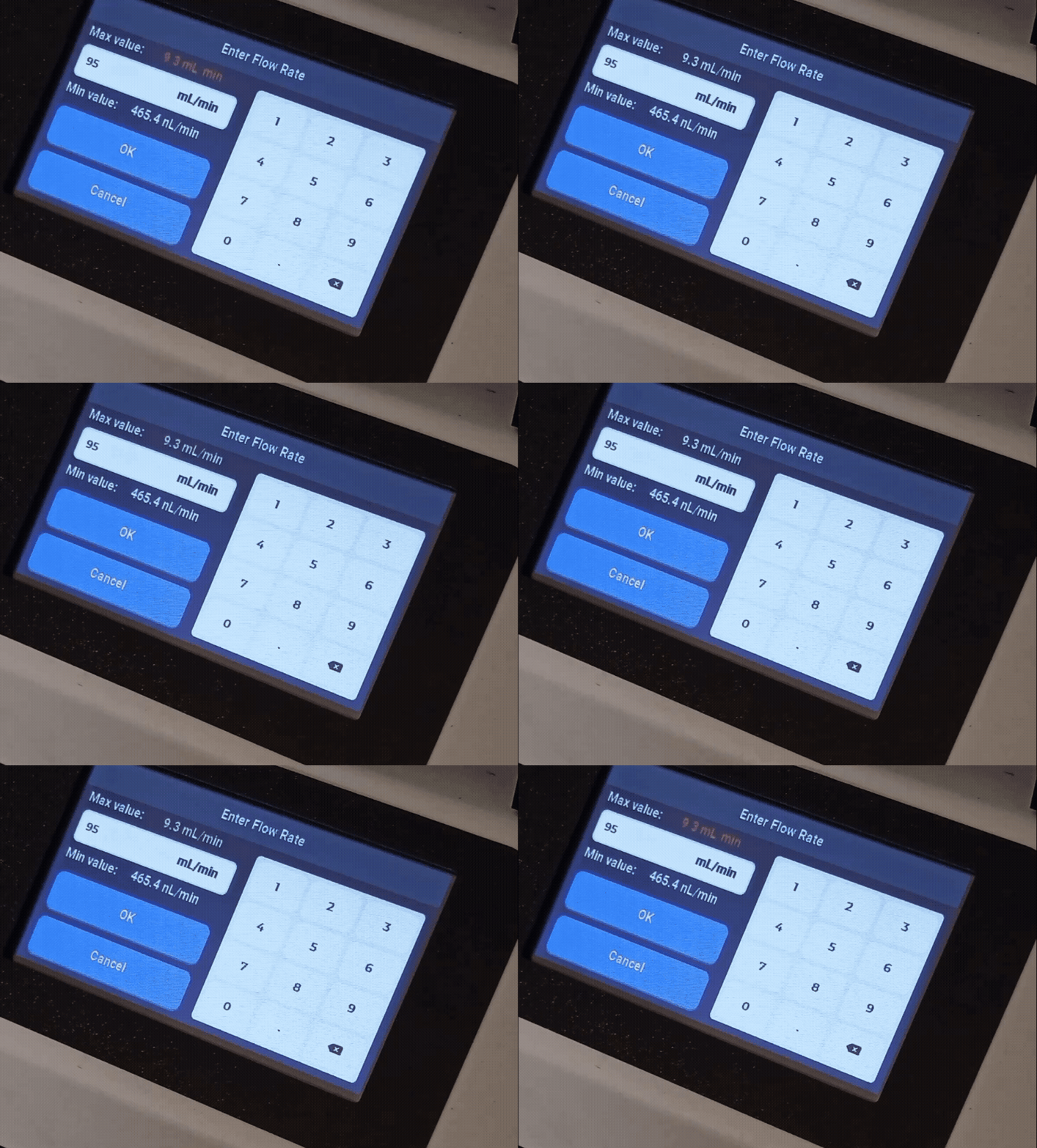
No matter how good your syringe pump is, it will not be practical if the user interface is not user-friendly and easy to control.
The interface should automatically perform all necessary calculations, include error-prevention mechanisms, and be intuitive enough to understand at a glance. Without error-prevention features, users may easily enter incorrect parameters.
Having error-prevention alone is not enough—it must also be presented in a clear and visual way. Systems that only generate error codes can severely degrade the user experience. You don’t want to interrupt your experiment just to look up what an error code means, do you?
Noise, Vibration, and Flow Stability
Noise, vibration, and flow stability are the parameters where a good syringe pump truly stands out. Even if all the parameters described above are met, achieving quiet and stable flow is not possible unless top-level hardware and software technologies are used to implement them.
For more information, you can contact us by emailing info@asensis.net.